
By Jim Keaty: A Keaty Real Estate Field Briefing · Updated August 19, 2026 . Tell Keaty What You Own →
“When the rockets come, be ready.” — Jim Keaty
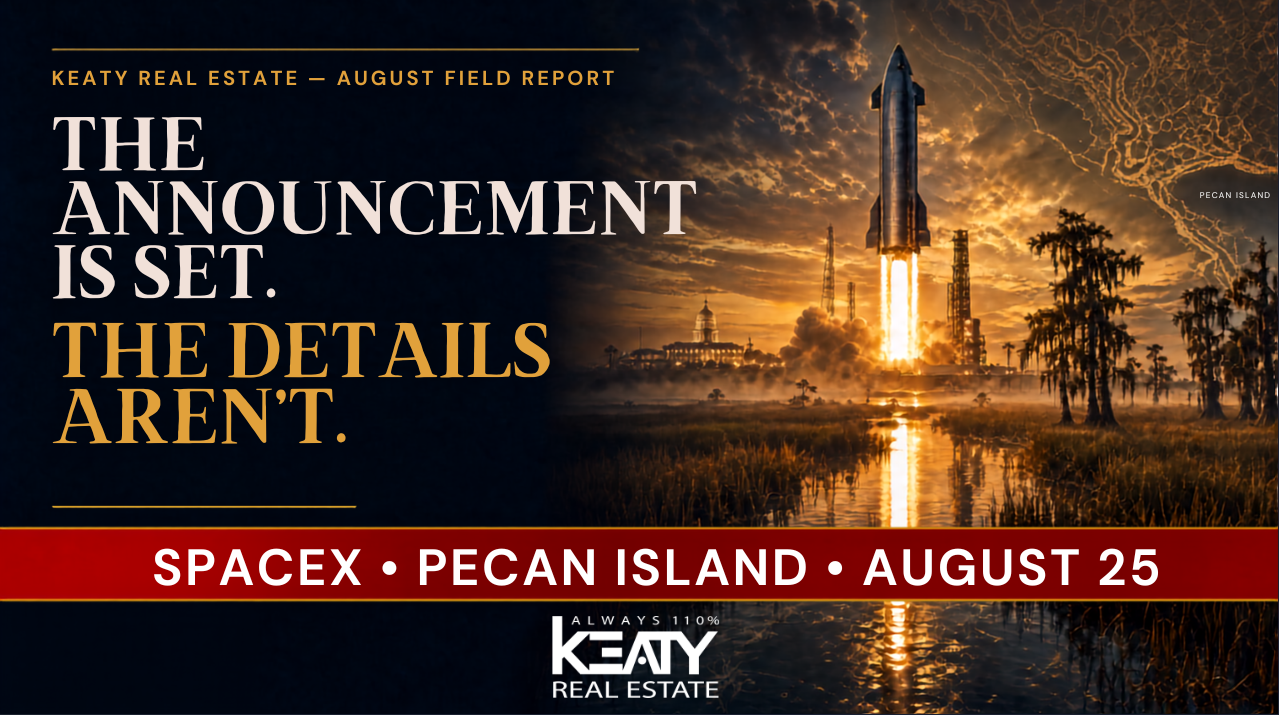
A conversation in Brownsville, a closer look at the coast, the law, the old rigs and the invitation that moved this story from rumor to a date on the calendar.
The questions around Pecan Island are getting sharper.
An invitation from the governor’s office and Louisiana Economic Development lists Gov. Jeff Landry and LED Secretary Susan Bourgeois for an 11 a.m. August 25 announcement in Abbeville. The invitation itself does not identify a project. NOLA.com now reports that the event will announce Louisiana’s deal with SpaceX, including a planned coastal launch facility on an approximately 18-mile stretch about 45 miles southwest of Lafayette. The report says the state expects SpaceX to control roughly 130,000 acres through a sale, donation, or long-term lease and that coastal-protection measures are expected to be part of the deal.
That reporting answers some of the questions we had last week and raises others. We now have a more concrete reported location, a reported path to land control, and a reported launch-facility purpose. We still do not have the documents that matter most to nearby families: the executed agreement, facility boundary, access map, investment terms, job schedule, environmental conditions, coastal-protection design, and a clear public process for questions and objections.

The invitation establishes a date, time, and state participants. It does not itself name SpaceX, the project location, or an investment figure.
What we know right now
There is a reported announcement. There is serious reporting. There are serious questions. But there is still not enough public detail to tell a family with a camp, a home, a tract of land, or a local business exactly what this will mean for them.
One number circulating is $45 billion. I have not found an attributable public source for it. Until the state or company identifies a number and explains what it covers, I will not repeat it as fact.
A conversation with Craig Grove in Brownsville
I had a great conversation with Craig Grove, the Brownsville-area broker-owner many people know as The Brownsville Guy. He has spent roughly twelve years watching a proposed SpaceX facility become part of the daily reality around Brownsville, Boca Chica, and South Padre Island. I called him because I did not want to talk about Brownsville as a slogan. I wanted to hear from somebody who has watched the good, the hard, and the unexpected parts play out in real life.
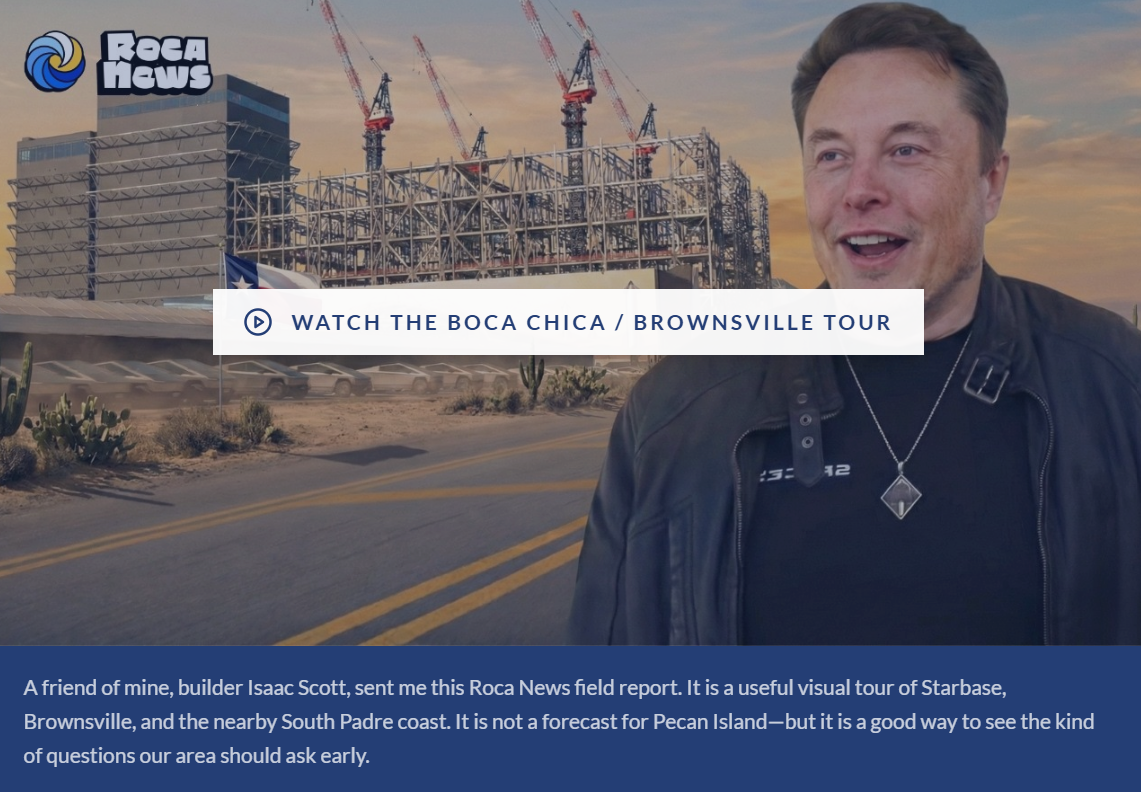
Craig’s most useful point was not that Pecan Island will become Brownsville. It will not. The geography is different. The land ownership is different. The access, wetlands, regulatory path, and the project itself may be different. The lesson is that a community does better when it insists early on knowing the actual operating footprint, where the workforce will live, what access changes are coming, and which commitments exist in writing rather than in conversation.
There are positive things people in Brownsville experienced: new attention, new jobs and service demand, more interest in local businesses, and a sense that their community had become part of a national story. There were difficult things too: pressure on housing, uncertainty for nearby property owners, changing traffic and access patterns, and long arguments about noise, public land, environment, and who gets to make decisions. Neither side of that experience should be ignored. It is exactly why we need neutral information here before momentum gets ahead of the facts.
For property owners, the right move is to keep your options open.
Craig also told me that a major SpaceX announcement can draw attention well beyond the immediate community. In Brownsville, that attention came from people who wanted to live near the activity, people who saw a possible workforce-housing need, investors watching the area, and people who simply wanted to be close enough to see launches. I cannot verify every buyer story or predict who may show interest here. But the larger point is reasonable: when a nationally visible project begins to take shape, property demand can arrive before local owners have decided what they would or would not consider.
That does not mean everybody should sell, lease, or put a camp on the market. If your plan is to stay, keep your land, and enjoy the place you already love, you do not need to do anything. A home or camp could remain exactly that – and, depending on the final design, it may one day be a good place to watch a historic change from a distance. But for owners who might consider a sale, lease, temporary rental, RV use, workforce housing, or a commercial opportunity at the right terms, this is a good time to think privately about what those terms would be.
If you would only sell at a price you never expected to receive, that is worth a thoughtful broker conversation—not a rushed rumor-driven decision. An asking price should reflect what you would truly accept, current market evidence, the property’s actual characteristics, and the risk that no buyer may meet it. Keeping your property visible to the right people can preserve an opportunity; it does not obligate you to take it.
That is why we created the private Keaty Property Opportunity List. You can tell us about land, a home, a camp, a rental, RV space, or a commercial site without publicly listing it for sale. If a developer, buyer, employer, or other real demand emerges and you are interested, we will already know what you have and what you may consider. If you want your property actively marketed, we can also discuss a public listing. Either way, you stay in control.
“The point is not to decide today whether this is all good or all bad. The point is to make sure local people get the facts early enough to protect what matters and take advantage of what is real.”— Jim Keaty
Why a coastal site could be attractive and why that is not the whole story.
The reported acreage is enormous, and that makes it tempting to draw a straight line from size to conclusion. We should resist that. A large land-control area can include operating space, setbacks, mitigation land, safety buffers, access routes, future expansion space, or ground that never becomes a building pad at all. Until we see a defined boundary and a defined facility, nobody can honestly tell a nearby owner whether the practical effect will be immediate, indirect, or minimal.
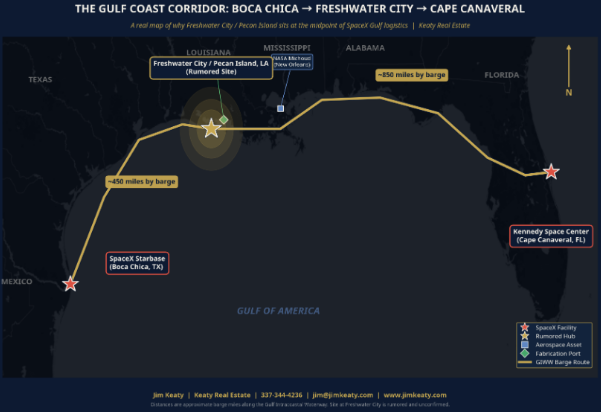
There is a reason people keep looking at this stretch of coast. It has water access, room, industrial precedent, and a location that could be interesting to a company that wants additional capacity over time. SpaceX has publicly discussed a future in which launch operations become more airport-like, with more frequent activity and greater infrastructure needs. Those broader ambitions explain interest in additional locations. They do not prove an hourly launch schedule, a Pecan Island launchpad, or any other specific Louisiana plan.
The same goes for the old offshore rigs. We looked into the two drilling rigs SpaceX bought years ago because the question makes sense: if an offshore component were needed, could those old rigs be moved into the Gulf near Pecan Island? The answer is no—not as a current Louisiana lead. SpaceX sold both in 2023 because they were not the right platform. One was documented as dismantled in Türkiye; the other was later listed as towed toward Aliağa after the sale. That does not rule out future sea-based operations, but it does mean those old rigs are not evidence of a Louisiana plan.
Two short videos that help put the questions in context
The presentation I have been sharing includes these two visual references. They are not evidence of a specific Louisiana design. They simply help show why launch reliability, sea recovery, access, and emergency planning belong in the questions local people ask before any final project plan is accepted.
Video 1. Recovery is part of the picture.
A Falcon 9 drone-ship landing provides visual context for the recovery and logistics questions behind the old-rig conversation.

Video 2. Safety is not an abstract question.
This Blue Origin video is included as a reminder that a serious public conversation should ask specific questions about safety, emergency response, and accountability.

The coast, the marsh, and the people who already live here
One part of this story has not received enough attention: any serious coastal facility would have a powerful incentive to protect the ground it sits on. Dr. Gary Kinsland, a UL Lafayette geophysicist, recently told KATC that protection built for a coastal development could potentially provide some hurricane benefit for people inland. That is a potential positive worth asking about, not a promise we should take for granted.
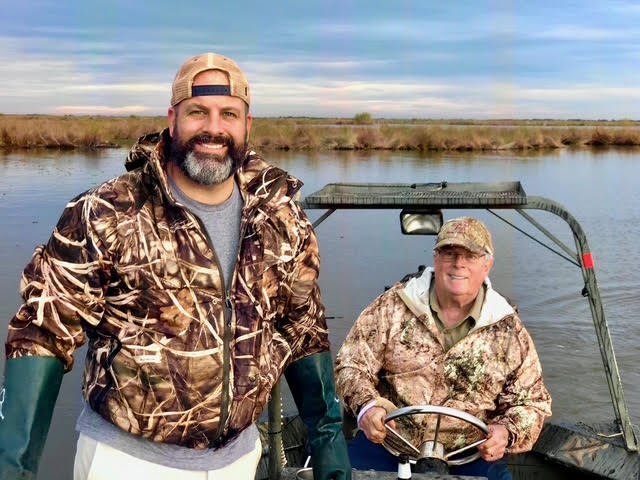
The marsh is not an empty backdrop. It is where families hunt, fish, crab, work, and build memories across generations.
Dr. Kinsland also made the tradeoffs plain. The immediate footprint of a developed facility would no longer be marsh. Roads, parking, pilings, and buildings could create localized changes. His conclusion is the right one for this whole conversation: “It’s never purely positive or purely negative.” If this moves forward, the questions are not just whether shoreline protection is promised. They are what it looks like, who pays to maintain it, how far its benefit extends, how the marsh is mitigated, and how access, hunting, fishing, crabbing, and camp life are treated in the final plan.
A community group is asking to be heard
There is now a growing local group of residents, hunters, fishermen, farmers, guides, and other people connected to the Pecan Island area who are organizing under the name Stop SpaceX. The group’s own site describes a coalition focused on the migratory flyway, wetlands, outdoor traditions, and the ability of local communities to participate in decisions that may affect their livelihood. KLFY and the Louisiana Illuminator have separately reported that the group formed in early August and has hosted resident video calls as people try to understand a project for which public details have been limited.
A necessary distinction
The group’s concerns about wildlife, access, safety, water, noise, and the future of local traditions are their community perspective—not settled findings about a final project. They deserve to be heard and tested against the actual plans, permits, engineering, and environmental review when those materials become public.
What I find important is that the concerned residents are not all saying the same thing or demanding the same outcome. One longtime local quoted by the Louisiana Illuminator said he could be open to a facility if it brings meaningful jobs and real environmental protection, but said no such commitments have been made public. That is a reasonable place for this community to be: not anti-growth by default, not willing to hand over trust without detail, and determined not to let the people who live, hunt, fish, farm, and work here become an afterthought.
If you want to understand that point of view directly, read the group’s materials and the local coverage. You do not have to agree with every claim to recognize that people who know this coastline intimately should have a meaningful voice in its future.
The law is real. So are its limits.
Act 391 changed the legal conversation by creating a narrow potential expropriation route for qualifying large aerospace projects. That deserves attention. But it is not a blank check to take homes. The statute’s qualifying 20,000-acre project property must contain no residential structures, and a taking would still require notice, appraisal, good-faith acquisition efforts, and court process. Another large-project aerospace law, Act 874, also uses a 20,000-acre threshold for certain civil-liability protections. Those laws are meaningful. They still do not identify a specific Pecan Island project boundary or make any family’s land subject to an automatic taking.
If you receive an offer, option, survey request, right-of-entry document, appraisal package, NDA, or formal notice, do not rush. Keep records. Get independent Louisiana legal advice before you sign. That is not alarmism. It is common sense whenever a large project may be approaching your family’s property.
What Tuesday needs to answer
If Tuesday brings the announcement people expect, the headline should be the beginning of the work—not the end of it. I will be looking for the actual project entity, who controls the land, a map of the operating footprint, the facility type, capital investment and its time horizon, construction and permanent jobs, coastal-protection commitments, access plans, permits, public-comment opportunities, and the path for local businesses and residents to get answers.
Until then, the honest position is simple: we have more evidence than we did a few weeks ago, but we still have less certainty than a good headline might suggest. The strongest thing local people can do is stay informed, avoid rushed decisions, and make sure the conversation stays grounded in the documents that eventually have to exist.
When the announcement is made, this is where we will separate the headline from the actual terms.
We will add the named project entity, investment figure and time horizon, jobs, site and access maps, land-control structure, permits, coastal commitments, and public-comment opportunities as soon as they are attributable. Until then, these fields stay open by design.

Owner FAQ
A few practical questions before you share your property.
Does joining SmartLand publicly list my property for sale?
No. The Property Opportunity List is private. It helps Keaty Real Estate understand what owners may consider if a real opportunity appears; it does not put a property on the public market.
Do I have to sell, lease, rent, or develop anything?
No. Joining is not a listing agreement or a commitment. You can keep your property, wait, or say you would only consider a particular kind of opportunity at terms that work for your family.
Can I include a camp, rental, RV space, home, or business site?
Yes. The list is designed for more than vacant land. Tell us about the property type and any use you may consider, including a camp rental, temporary housing, RV space, commercial site, or a traditional sale or lease.
What should I have ready before I start?
Start with the property address, a nearby road, or a location you can identify. You can then tell us what you own, what questions you have, and whether you prefer to stay private unless an opportunity fits.
A personal note from Jim:

Please consider supporting my big brother, Will Keaty, for District Judge.
This is separate from the SpaceX reporting, but it matters deeply to my family. If you live in Lafayette and know of a good sign location, it would mean the world to us if you would consider sharing it. You can also visit Will’s campaign site to learn more about him and his race.
Learn More about Will Keaty: https://willkeatyforjudge.com/
Suggest a Lafayette Sign Location: https://keatytool-wpiexrkq.manus.space/request-sign
Thinking about buying, selling, or just trying to understand what this means for you?
I’ll give you a straight answer.. whether you own a camp in Pecan Island, are eyeing land along Hwy 82, or just want to know what this could do to Abbeville real estate values. No hype. No pressure.
Contact me today at: